John Carter’s Duel to Save Dejah Thoris
A Princess of MarsJohn Carter’s intervention at the Thark council saves Dejah Thoris when a young warrior attacks her, and the killing that follows abruptly changes Carter’s standing among the Tharks. The episode joins rescue to a paradoxical reward: Carter protects a vulnerable captive, yet gains the honor and position of a chieftain through lethal violence. Its consequences extend beyond the council, framing his later effort to show that a warrior’s strength need not exclude kindness.
The interruption of the council
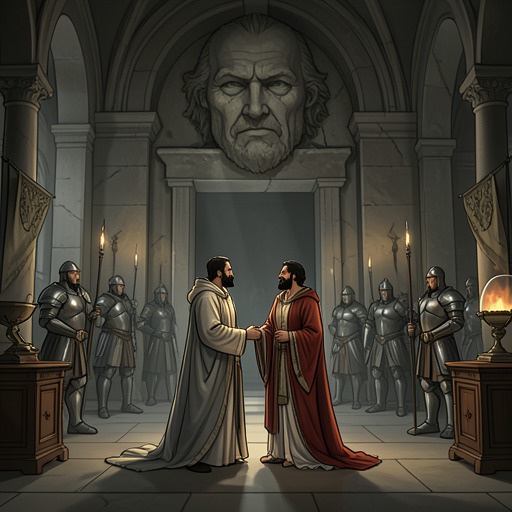
As Tars Tarkas rises to speak, Carter sees an expression unlike any he has observed on the green Martian warrior: a struggle with himself, his inherited nature, and ancient custom, briefly softened by apparent kindness. Whatever Tars Tarkas is about to say remains unspoken. A young warrior, apparently reading the older men’s mood, rushes from the rostrum steps and strikes Dejah Thoris, knocking her down. He then stands over her and laughs at the council.
The attack cuts across a moment that might have permitted compassion or a change in the council’s treatment of its captive. Carter later emphasizes that the time taken to record the sequence does not mean he paused; as he watched the blow aimed at Dejah Thoris, he was already moving across the hall. The shift from Tars Tarkas’s hesitation to the young warrior’s assault turns a possible act of restraint into an immediate demand for intervention.
Carter’s intervention and the duel
Carter reaches the warrior as the latter’s laughter begins. Though far smaller than his opponent, Carter closes the distance and attacks at close quarters. When the warrior draws a short sword, Carter draws his own and presses the fight so tightly that his opponent cannot use the sword effectively. The warrior also tries to reach for a pistol, but Thark custom requires a combatant in a private fight to use no weapon other than the one with which he was attacked.
That restriction is consequential: the attempt to change weapons does not give the young warrior an advantage, and Carter remains close enough to prevent him from using either weapon effectively. The contest ends with the warrior dead. Carter then rises, lifts the injured Dejah Thoris, and carries her to a bench at the side of the hall. The rescue is therefore not simply a victory in combat: it ends the immediate assault and returns her to a place of relative safety within the council chamber.
Recognition and the price of status
The other Martians first respond in astonishment, then break into laughter and applause. Carter does not understand the applause at the time; only later does he learn that it is an uncommon expression of approval among them. The delayed explanation makes the audience’s response part of the episode’s meaning: what initially sounds like an unintelligible reaction proves to be public recognition.
Carter also learns that killing the warrior has brought him the dead man’s position and the honors due to a conqueror. By the Tharks’ crude customary justice, Carter has won his spurs and become a chieftain. He later connects this new status to his unusual freedom and the tolerance he receives in the audience chamber. The rescue thus changes both Dejah Thoris’s immediate circumstances and Carter’s place in Thark society, but the society recognizes his protection of her through the same combat-based order that produced the attack.
A wider argument about warrior conduct
The duel sits within a recurring contrast in Carter’s conduct: he can be a formidable fighter while treating animals with care. Two thoats come to him from warriors whose equipment he wears, and he learns to handle them as well as native riders. He explains that Thark riders commonly use pistol butts to force a thoat into obedience when it fails to respond to telepathic instructions, persisting until the animal submits or throws its rider.
When Tars Tarkas asks how Carter’s animals obey him, Carter answers that kindness has practical value even for a warrior. He argues that a thoat trained through kinder treatment will obey in battle or on the march, improving its rider’s fighting efficiency; he also recalls Tars Tarkas’s warning that unpredictable animals can turn victory into defeat. The argument does not erase the violence of Carter’s rise at the council, but it complicates the culture’s measure of strength: care, presented as an advantage to the community as well as to the individual, can serve martial effectiveness rather than oppose it.
Carter’s later challenge to Thark leadership makes that tension explicit. He asks the assembled warriors where their jeddak was during the fighting and contrasts the ruler’s treatment of defenseless people with the courage of Tars Tarkas, whom he presents as a brave and noble alternative. He then calls for Tars Tarkas to become Jeddak of Thark. The council rescue does not itself settle that political contest, but Carter’s new standing as a chieftain helps explain why his later appeal can be made before the assembled leaders. Across these connected moments, combat earns authority, while Carter presses the Tharks to judge a leader by courage and nobility rather than domination alone.